Why Sign Language Is a Full Language, Not Just Hand Gestures
Sign language features complex grammar, syntax, poetry, and productivity rules, proving linguistic status beyond simple gestures. Explore its structure.
Editorial Team
Direct Answer
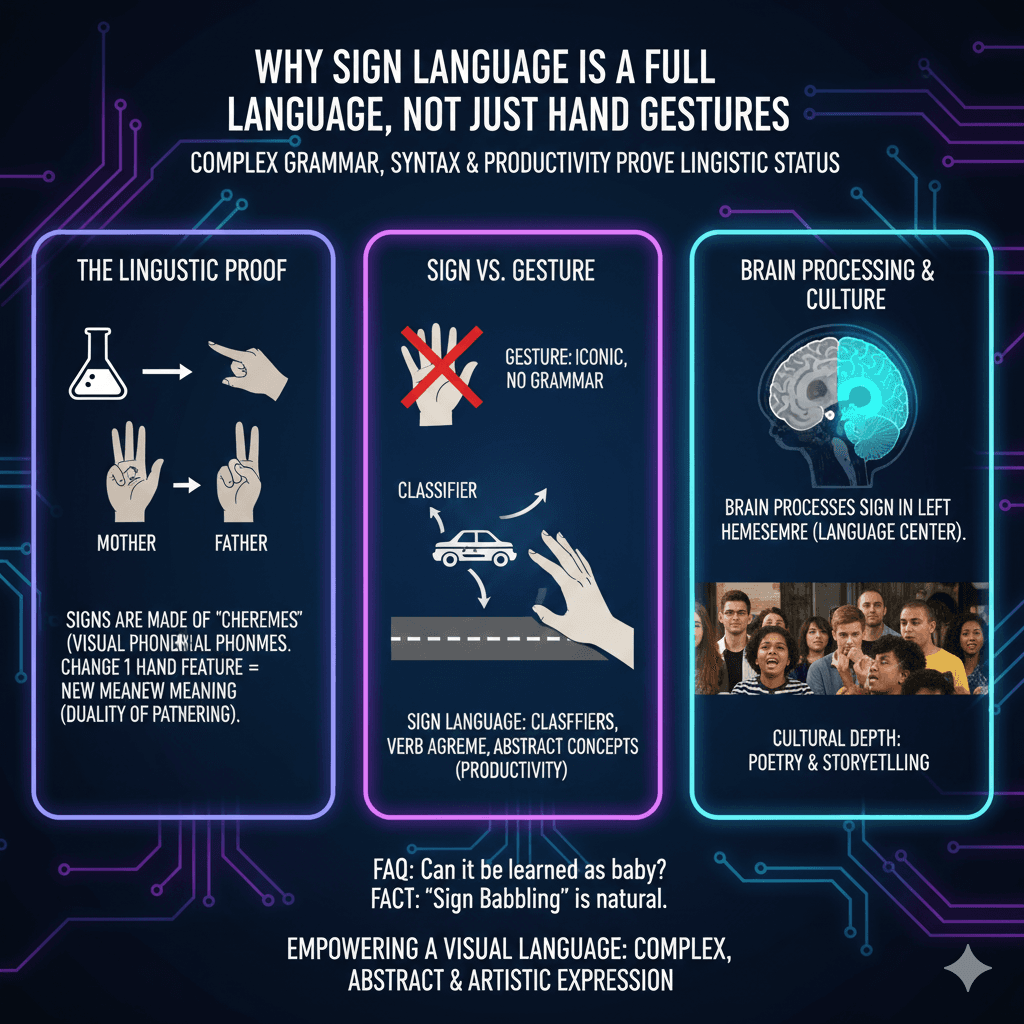
Linguists have proven that sign languages are 'full' languages because they possess all the structural requirements of spoken ones: Phonology (rules for handshapes), Morphology (building words), Syntax (sentence rules), and Semantics (meaning). A simple gesture, like waving goodbye, has no grammar, but a sign language can express abstract philosophy and complex legal concepts.
The Linguistic Proof
In the 1960s, Dr. William Stokoe revolutionized the field by showing that signs are made of 'cheremes' (the visual equivalent of phonemes). Just as changing the sound /b/ to /p/ changes 'bat' to 'pat,' changing a handshape in a sign changes its entire meaning. This 'duality of patterning' is a hallmark of true human language.
Sign vs. Gesture
- Gestures: Are typically iconic (miming) and lack a fixed grammatical structure. They cannot be used to discuss the past or hypothetical futures effectively.
- Sign Languages: Use 'Classifiers' to describe the size, shape, and movement of objects with mathematical precision. They have rules for verb agreement and can create infinitely many new sentences (productivity).
Brain Processing
Neuroscience shows that the brain processes sign language in the left hemisphere, the same area responsible for spoken language. This proves that the brain treats signing not as a visual art or a set of 'pictures,' but as linguistic data. [Image showing a brain scan highlighting the Broca's and Wernicke's areas active during signing]
Cultural Depth
Sign languages also feature their own poetry, storytelling traditions, and humor. 'Visual Vernacular' is a specialized form of sign language performance that blends mime and cinematic storytelling, showing a level of artistic complexity that simple gestures could never achieve.
FAQ: Can it be learned as a baby? Yes, 'Sign babbling' occurs in infants exactly when 'vocal babbling' would. Link: Mute myths. Reference: The Phonological Organization of Sign Languages