What Is Sign Language and How Does It Work?
Sign language is a complete visual language using hand shapes, movements, facial expressions, and body posture to convey meaning. Learn its structure and daily use.
Editorial Team
Direct Answer
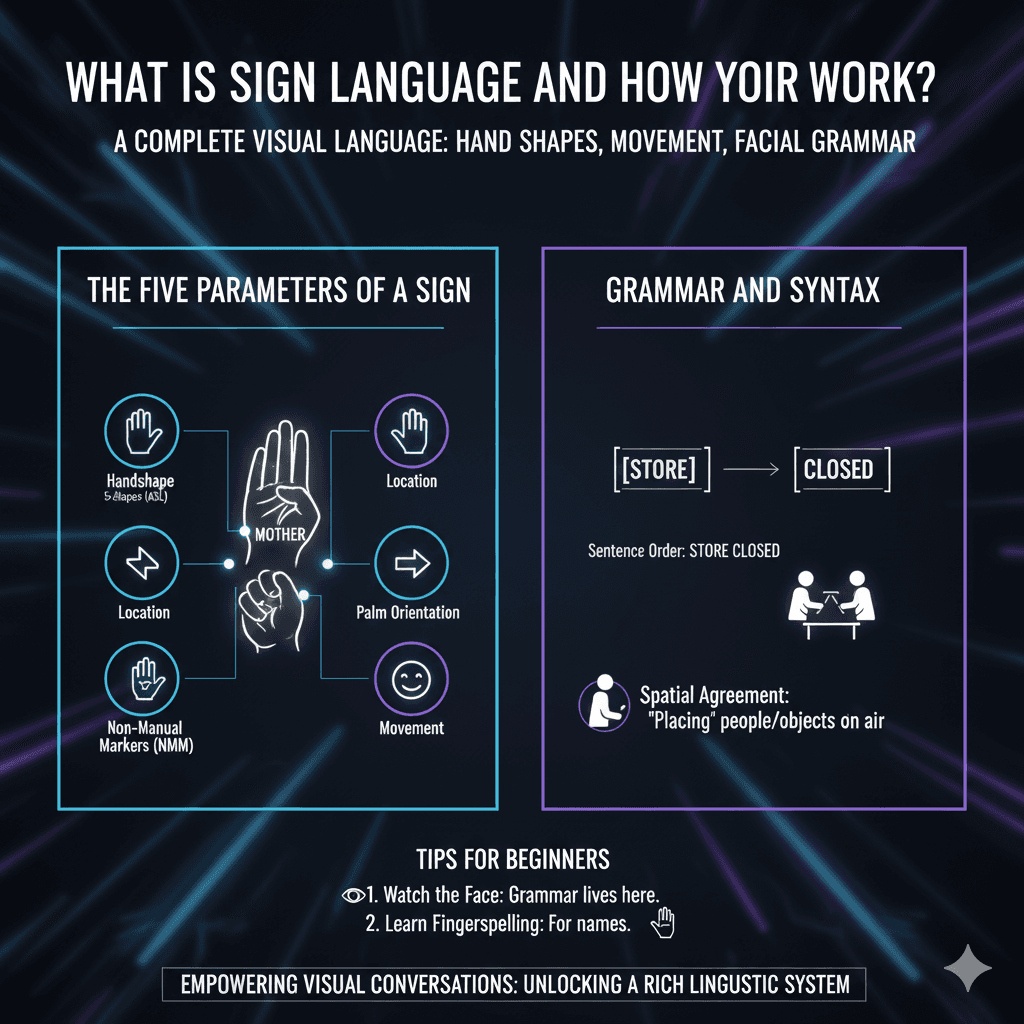
Sign language is a natural, sophisticated language with its own distinct grammar and syntax. It operates through five core parameters: handshape, location, movement, palm orientation, and non-manual markers (such as facial expressions and head tilts). It is not a manual version of spoken language, but a separate linguistic system optimized for visual processing.
The Five Parameters of a Sign
To sign correctly, five elements must be synchronized. A slight change in even one parameter can change a word's meaning entirely (e.g., the difference between 'mother' and 'father' in ASL is primarily location):
- Handshape: There are over 50 commonly used handshapes in ASL.
- Location: The 'signing space' typically extends from the top of the head to the waist.
- Movement: Direction and speed can indicate verb tense or intensity.
- Palm Orientation: Whether the palm faces in, out, up, or down.
- Non-Manual Markers (NMM): Eyebrow positions and mouth morphemes function as the 'tone of voice.'
Grammar and Syntax
Contrary to popular belief, ASL does not follow English word order. It often uses a Topic-Comment structure. For example, 'The store is closed' is signed as [STORE] (topic) + [CLOSED] (comment). Spatial agreement allows signers to 'place' people or objects in the air around them to refer back to them later without repeating names.
Tips for Beginners
- Don't just watch the hands: Look at the signer's face; that is where the 'grammar' lives.
- Learn the alphabet: Fingerspelling is essential for proper names and technical terms.
FAQ: Is it just gestures? No. Gestures are random; signs are rule-bound. Link: Regional variants. References: NIDCD | Gallaudet University ASL Resources