How Government Assistance Helps Mute People Access Communication Tools
Government programs provide grants, subsidies, and devices for mute individuals to access AAC tools, speech apps, and adaptive tech. Learn eligibility, applications, and support options worldwide.
Editorial Team
Direct Answer
Government assistance programs provide critical financial support for mute individuals to acquire Augmentative and Alternative Communication (AAC) systems, tablets, and specialized software. By 2026, many national health and disability schemes, such as the ADIP Scheme in India and Medicaid in the US, have expanded their coverage to include mainstream tablets (like iPads) when used as dedicated speech-generating devices. These programs aim to bridge the communication gap, ensuring that non-verbal individuals can participate fully in education, employment, and social life.
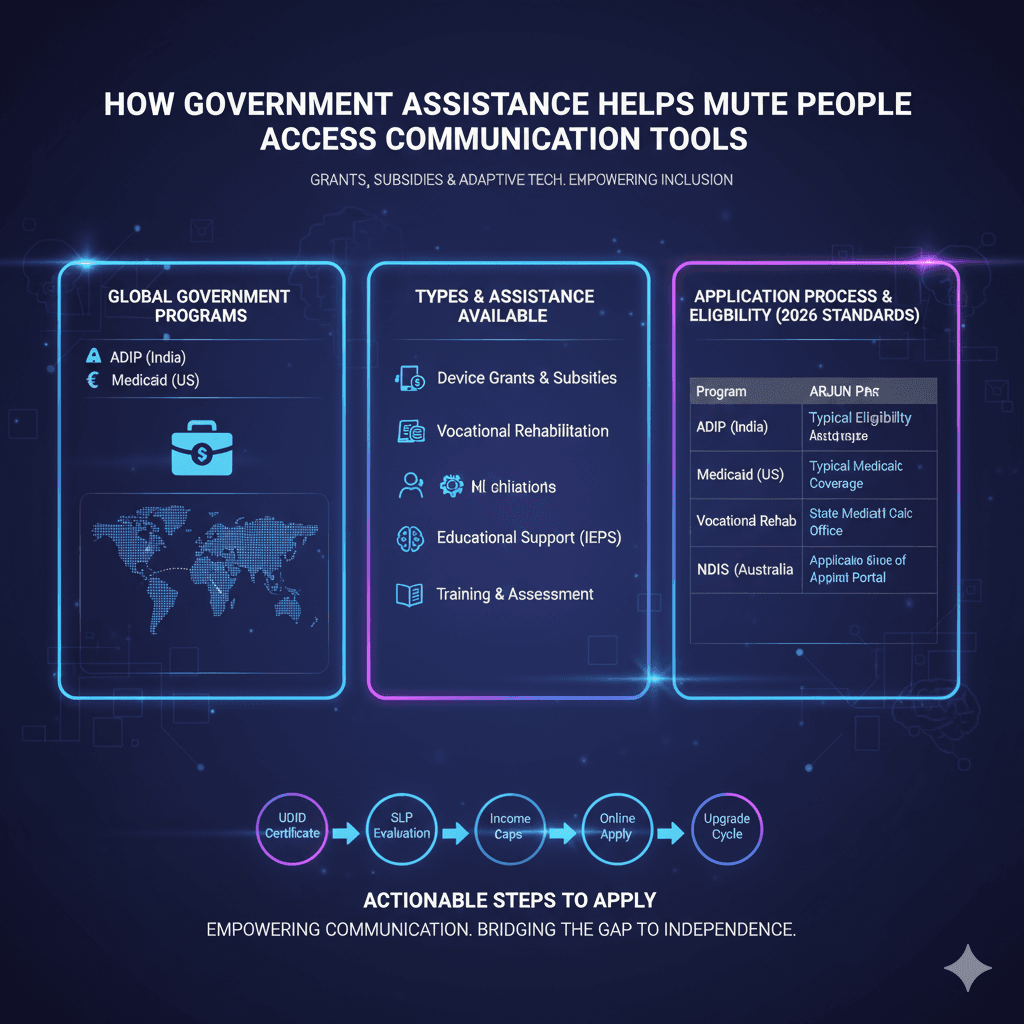
Global Government Programs Overview
Most government aid is channeled through vocational rehabilitation, educational support, or national health insurance. For instance, the UN Convention on the Rights of Persons with Disabilities (CRPD) has pushed member nations to subsidize 'ICT' accessibility. In India, the ADIP Scheme (revised in late 2024 and active through 2026) provides modern assistive devices, including tablets and high-end AAC tools, to eligible citizens with at least 40% disability.
Types of Assistance Available
- Device Grants & Subsidies: Full or partial funding for tablets, speech-generating devices (SGDs), and specialized eye-tracking hardware.
- Vocational Rehabilitation: Funding specifically for tools that help a mute individual obtain or maintain a job.
- Educational Support (IEPs): In many countries, schools are legally required to provide communication tools for students as part of their Individualized Education Program.
- Training & Assessment: Coverage for speech-language pathologists (SLPs) to evaluate and train users on new technology.
Application Process & Eligibility (2026 Standards)
| Program | Typical Eligibility | Primary Coverage | Application Portal |
|---|---|---|---|
| ADIP (India) | Income < ₹30k/mo; 40% disability | Tablets, AAC, TLM Kits | ARJUN Portal |
| Medicaid (US) | Medical necessity (physician-led) | Speech-Generating Devices | State Medicaid Office |
| Vocational Rehab | Employment-age individuals | Work-specific adaptive tech | State/Regional VR Office |
| NDIS (Australia) | Assessed support needs | Customized AAC solutions | NDIS MyPlace Portal |
Actionable Steps to Apply
- Get a UDID or Disability Certificate: Most programs require a formal medical certification of mutism or speech impairment.
- Secure a Professional Evaluation: A Speech-Language Pathologist (SLP) must usually document which specific device is medically or educationally necessary.
- Check Income Caps: Many grants (like ADIP) offer 100% funding for lower income brackets and 50% for middle-income groups.
- Apply Online: Use specialized portals like India's ARJUN Portal or the US Medicaid provider network to submit documents.
FAQs
- Can I get an iPad through the government? Yes, if it is 'locked' as a dedicated communication device and prescribed by an SLP, many programs now cover it as Durable Medical Equipment (DME).
- How often can I upgrade? Most programs allow for a replacement or upgrade every 3 to 5 years.
Link: Best budget tablets for AAC. References: DEPwD ADIP Guidelines 2026 | Medicaid Assistive Technology | UN Disability Rights