The Future of Communication Accessibility
AI neural interfaces, universal design, and policy shifts promise seamless communication for mute people by 2030. Explore emerging tech and inclusion trends.
Editorial Team
Direct Answer
By 2030, the barrier between thought and speech will be thinner than ever. The future of accessibility lies in Brain-Computer Interfaces (BCI), real-time AI sign-to-speech translation, and 'Ambient Computing', where the environment itself adapts to the user's communication needs automatically.
Emerging Technologies
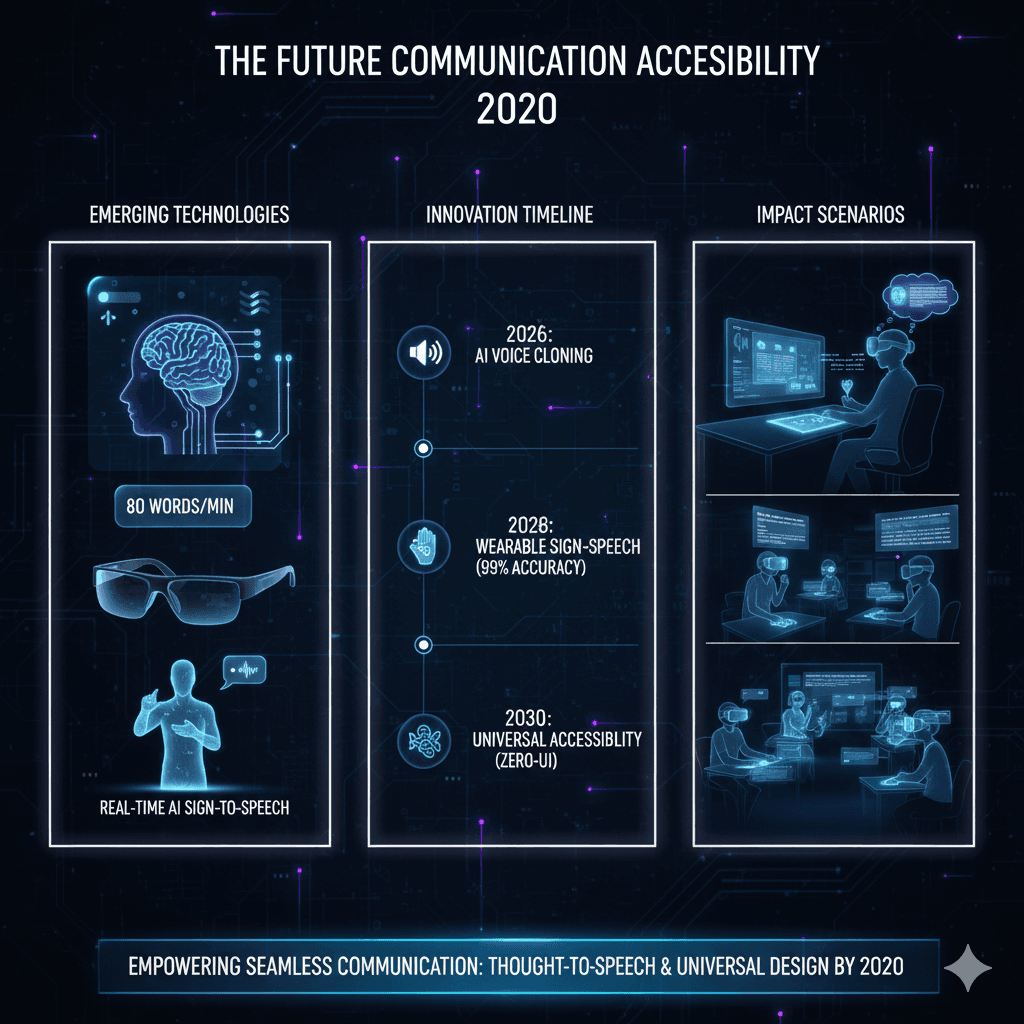
High-bandwidth neural implants are moving from clinical trials to specialized consumer use, allowing users to 'type' with their thoughts at speeds exceeding 80 words per minute. Meanwhile, AR (Augmented Reality) glasses are set to provide real-time holographic sign language interpreters during face-to-face meetings.
Innovation Timeline
- 2026: AI voice cloning becomes a standard tool for personalizing AAC devices.
- 2028: Wearable sign-language-to-speech translators reach 99% accuracy in diverse environments.
- 2030: Universal accessibility laws (like the expansion of the UN CRPD) mandate that all public digital interfaces must be 'Zero-UI' compatible.
Impact Scenarios
In the near future, workplaces will auto-adapt to a mute employee's presence, switching communication channels to text-first or visual formats without the need for manual setup. Schools will use VR/AR to create fully inclusive classrooms where every student's communication method is translated in real-time for their peers.
Getting Prepared
The best way to prepare is to advocate for inclusive design today. Organizations should focus on 'Universal Design', creating tools that are accessible by default rather than as an afterthought.
FAQs
- Is this technology private? The industry is currently developing 'Neural Privacy' protocols to ensure that thought-based communication remains under the user's total control.
Link: AI in communication today. References: Intelligent World 2030 | The Future is Assistive